Monday, June 27, 2011
Mulled Wine Recipe
Jen asked for my mulled wine recipe, mentioned in passing in my winter festival post.
Spicy aromas of cloves, cinnamon and nutmeg wafting from mugs of hot wine, hands clasped around mugs to warm them, cold winter air and warm fire: there is something about mulled wine / gluhwein / vin chaud that evokes the best part of winter, a comfort blanket for your taste buds. Certainly at our last winter festival it went down very well, the pot drained dry in no time, leaving me making a note to double the quantities next year.
It’s more of a method than a recipe. I do most of it to taste, so don’t have exact quantities for everything, but that’s half the fun of it: tasting a sip now and then as it brews, the spices getting headier with the warmth, adjusting the sugar quantities, so that the acid edge is softened but without it getting sickly sweet and cloying.
Choose a red wine that is drinkable for a start. This isn’t a way of disguising a disgusting plonk, but rather a way of adding to a good well bodied wine. Having said that there is no point using a fine wine of complex structure and subtle notes either. Strong wines aged in oak and full of tannin tend to challenge the spices with too much of their own personality. So the best I’ve found is a simple but medium bodied claret, affordable but not dirt cheap. Here in South Africa I use the Drostdy-Hof Claret Select which now comes in boxes, making it affordable enough for our large gatherings.
Ingredients
4 litres red wine
2 oranges
20 - 30 whole cloves
3-4 sticks cinnamon
½ a nutmeg grated finely
Sugar
Decant the wine into a large pot. Press the cloves into the skin of the oranges so they are studded on both sides. Cut the oranges in half and float them in the wine. Add the cinnamon sticks and grated nutmeg.
The sugar needs to be added to taste, so start with about a cup and taste again when that has warmed and dissolved. The idea is to take the sharpness from the edge of the wine, but not to get too sickly sweet. Always start with less sugar and add a bit more once the wine has warmed until you’ve got the right balance.
Warm the wine over a medium heat, stirring occasionally. Bring it to a point where it is steaming and a few small bubbles are breaking the surface. DON’T LET IT BOIL or all the alcohol will evaporate! Keep it gently steaming over a low heat for about an hour to draw out the flavour of the spices.
Taste the wine every now and again and add a little more sugar if necessary or a little more spice. The spice will mellow and develop as the wine mulls, so expect the flavour to improve and deepen over the time it is brewing.
I don’t add anything else. Some other recipes do add fruit juice and brandy, but I like the simplicity of this with just a little fruit note added by the oranges and the warm aroma of spices lifting the spirits. Ladle into mugs and sip steadily before it cools.
Monday, June 20, 2011
Winter Festival - Fire and Light and Pots of Food
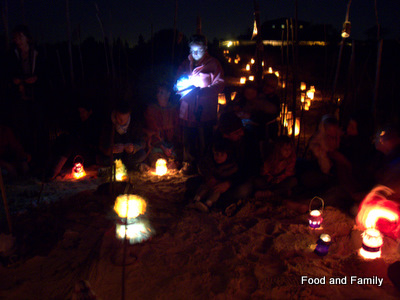
Our midwinter celebration, a festival of fire and light, giving kids old and young a chance to play with sparklers, make lanterns, sit mesmerised around a bonfire cradling mugs of hot soup and mulled wine, watching sparks fly into the air to join the stars.
By some miracle, year after year, we manage to have an evening that is clear and still, and this year too, the wind dropped on cue, the rain held off till after midnight, when everyone was already tucked up in bed and the bonfire burned in fine style.
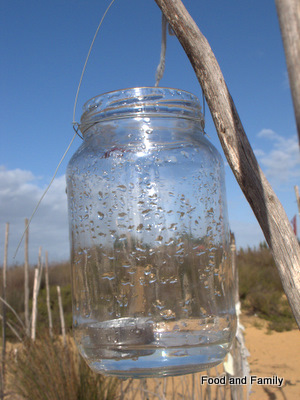
As we sat in the circle, the kids with lanterns parked in front of them, others hanging theirs on the sticks to make a colorful dancing circle of light around us, we read our blessings and St Francis' prayer, the girls sang the St Johns song that they all know from Waldorf school and there was a wonderful peaceful quality in the air.
Then it was time for sparklers, hot chocoolate, mulled wine and lighting the bonfire.
I needed my biggest pots – we had 45 people, 20 of them children, who were on hot chocolate, but even so the mulled wine vanished in a flash from my big stockpot. All the mugs from all three houses were requisitioned and we ate soup from mugs, moving on to sausage and boerewors rolls as the stalwart braai team produced them.
I’m going to need to invest in more pots if we have this many people next year – the lentil soup went down so well that the poor old braai master (my husband) only got one, not full, mug and no seconds and the mulled wine also ran out before he got a chance for seconds of that too... proof that everyone enjoyed it of course!
So I’ve made notes for next year, but there’s no guarantee that I’ll find that piece of paper or even remember that I did make notes – so reminder to self: make more soup and more mulled wine next year!
The rain poured down all night, putting out the fire very thoroughly and washing the colour from the crepe paper decorated lanterns.
When the sun came out in the afternoon the sandpit was washed clean of footprints and had taken on another form of beauty – the calm after the storm.
Thank you to all our friends for joining us and making this such a special occasion for all of us!
Wednesday, June 15, 2011
Aloo Gobi - The recipe
“She helped me wash the net curtains and she made lovely aloo gobi last week. ...”
Ever since watching Bend It Like Beckham ( a movie we loved so much when we first got the DVD that we watched it ten times in a row), I’ve had a vague desire to learn to make aloo gobi myself. I didn’t actually know what it was, but it sounded so satisfying, especially when Jess’ mother pronounced it. But I was cooking for small kids at the time and the most adventurous we got was chicken korma.
A few weeks ago I was researching some Indian recipes for a client and the aloo gobi quote popped immediately into my mind. Once the articles were despatched, I was left with several mouth-watering recipes begging to be tried out. The lamb dopiaza recipe I’ve already written about, so now I have to share the aloo gobi recipe with you, which was a revelation to me.
Cauliflower has never been a favourite vegetable for anyone in the family, so I knew I was taking a risk serving it up, even combined with the potatoes, which my family love in most guises. But I got away with it! Maybe because the cauliflower florets were small, just a little bit cooked out of shape and the same colour as the potatoes when coated with spices, but the girls gobbled up the aloo gobi without a protest. (Our son of course never touched it in the first place, but then I knew that was too much to expect.) I thought I was home and dry. Unfortunately the next time I cooked it they cottoned on and separated out the cauliflower pieces; my dastardly plot foiled...!
Anyway we loved it, deep spice flavours adding intensity to the bland vegetables but still allowing the creamy nuttiness of fresh cauliflower to come through. The recipe I eventually found is authentically Indian and though I have most of the spices, I don’t have asafoetida or mango powder. So I left them out and used a squeeze of lemon juice to add a touch of light acidity instead of the mango powder.
![]() |
| Lamb dopiaza and aloo gobi go really well together |
Recipe for Aloo Gobi
Ingredients
2 cups cut cauliflower florets
2 medium potatoes
2 cm fresh ginger root shredded
3 teaspoons ground coriander
¼ teaspoon turmeric
¼ teaspoon cayenne pepper
3 tablespoons oil
3 tablespoons water
Pinch asafoetida (optional)
1/2 teaspoon cumin seeds
2 green chillies
2 bay leaves
1 teaspoon salt
1 teaspoon mango powder (amchoor)
2 tablespoons chopped coriander leaves
Mix the shredded ginger, coriander powder, cayenne and turmeric together in a small bowl then add the 3 tablespoons water to make a paste.
Heat the oil in a pan. When it is hot enough, a cumin seed dropped in will crack immediately. Add the cumin seeds and asafoetida to the oil. As soon as the seeds crack add the green chillies and bay leaves and stir. Now add the spice paste and stir for one minute until the spices separate out from the oil.
Add the cauliflower and potatoes with salt and 2 tablespoons water. Stir them into the spice mix until they are well covered. Cover the pan and cook on a medium heat for about 15-20 minutes until the vegetables are tender. Stir carefully every 4 minutes or so to make sure it is not sticking to the pan.
Once the vegetables are tender, remove the pot from the heat and add the mango powder and chopped coriander. Stir it in and leave covered for a minute or two for the flavours to develop. Serve hot.
“Anyone can cook aloo gobi, - but who can bend a ball like Beckham?”
Tuesday, June 14, 2011
Winter on the Farm - Time for Marmalade Making
Soft swathes of mist drift over us, reaching around the hill behind us, bringing the vague memory of the sea with them, enveloping us in a cocooning blanket and muting the sounds of neighbours. The nearly full moon is dimmed, only a glow, and gradually all we hear is the steady drip, like rain in slow motion, of the misty dampness on our tin roof. Soft winter weather like this is a balm. We wake to a cool clear morning and, as we breakfast, a glow lights the line of the mountains that are our horizon. The children leave for school, I clear the detritus of breakfast and vacuum the accumulation of sand and dog hair from wooden floors until the sun creeps sluggishly into the sky. Then the day is awake, its beams reach in dazzlingly through the windows, dimming the lights which suddenly look feeble beside its glow.
It’s a time of new growth. Dusty dry ground turning green over night, studded with the vibrant yellow of little oxalis flowers, like jewels spread by a prodigal hand. The oranges, so impatiently awaited, are finally here in abundance. Huge bags for only R12. This weekend they were irresistibly cheap – I bought a bag and then my sister-in-law bought me one too, just in case I hadn’t got them. So I am flooded with them. Nothing for it but to give up an afternoon to making orange sorbet, stashing it away in the freezer for an easy dessert later in the season when oranges are no longer so plentiful.
My first batch of marmalade this year was a disaster. Two weeks ago I happily spent the time shredding peel: limes, grapefruit, lemons and oranges. It cooked away, scenting the house with citrus tang. Sugar added, it was slow to come to setting point. I divided my attention and went to help Youngest with her pony club project, researching the sport of carriage driving on the internet. She’s too young to be able to do this by herself, so ‘help’ really means a grumpy Mum, who would rather be doing something else, trying to find some resources that are simple enough for her to read and understand, and then giving up and writing most of it herself, while Youngest chooses the pictures.
In between mutterings I went and checked on the marmalade, which was nearly there but needed another five minutes. And we all know what happens when you let a computer take you away from the stove for five minutes... I was recalled to the kitchen 15 minutes later by the pervasive aroma of caramelised oranges, which, by the time it had wafted through to our office, was more than just a little hint of caramel. It took me a whole week to get the blackened pan clean. And the rest of the day to restore my sense of humour.
This weekend I took a deep breath and made another batch from my ever adaptable marmalade recipe, which can be three fruit or four fruit or even five fruit quite happily, according to whim. This time I stayed in the room with it. The marmalade is perfect.
Six golden glowing jars await their labels and I have plan to make another batch very soon, to fill the marmalade side of the shelf once more and get me though to the next orange season. Now I want to make some candied peel, which I love but have never tried to make myself.
The soft winter weather is about to be blasted into oblivion by a fine old Cape winter storm according to windguru so I’m getting a final load of washing done while the sun shines and the breeze veers round to the north-west. Two days of rain will be enough to pile the laundry basket high again, so it needs to be emptied in readiness. And then it is our winter festival this weekend – midwinter, middle of the year already. How did that happen?
Sunday, June 12, 2011
Stickers
The girls have been seized by sticker mania. They used to collect stickers in a vague kind of way, happy when they came their way, carefully adding them to their sticker books, but never actually spending their own money on them. Their sticker books are home-made, from those pocket files, with colourful card slotted into the pages; the plastic surface is perfect for holding stickers so that they can be peeled off again later.
Now swapping stickers has become a social activity. Every time they go to their friends’ houses the sticker books come too. New terminology has entered their vocabulary: scratchies are the 3D stickers with rough surfaces; smoothies, the slightly padded stickers with a vinyl surface; softies are stickers with a velvety surface. The value of the sticker depends on what other people are prepared to swap for it.
They exclaim over the deals that have been struck:
“I can’t believe she would swap all those stickers for just one scratchy”.
Conditions are made on the swaps:
“You can only have this one if you don’t swap it with anybody else.” or
"The mummy and the foal have to stay together or they'll be lonely"
I was late catching on to all this. It was only when they were bemoaning the fact that their friends have access to so many more new stickers than them, that I realised their swapping power was severely compromised. One set of friends have adults all over the place looking out for stickers for them. They get sent them from family in Germany; an older girlfriend at school in a nearby town gets interesting ones that she swaps with them; doting adults in the village pick them up for them when they see them. Our family had been falling behind! We hadn’t realised the seriousness of the situation...
When you’ve had no new stickers for a while it’s harder to interest anyone in swapping with you. And the girls hardly ever come shopping with me any more nowadays, so how were they to get new ones to add to their collection? One day visiting Shoprite I did glance through the stickers on display, but realised that I had no idea which ones were desirable and which ones naff. Obviously horse stickers were top of the list but what else? I didn’t get any. I told them to ask their friends where they got their stickers from. “The Crazy Store’ came back the answer.
Luckily there is a branch of the Crazy Store in the town near their brother’s school and we headed there after a piano lesson, armed with purses bulging from the proceeds of their market stall. They sat in the aisle of the shop next to the sticker display, examining them carefully, calculating costs and deciding on the appeal of each set. Most of the scratchies left had cars and planes on, just one set of flowers and one set of insects... they decided to buy three sets of stickers to share, including the flower scratchies. Then Middle daughter bought a further two sets just for herself, snapping up the insect scratchies and spending at least half her money altogether. Of course this threatened the balance, as now she would have far more scratchies than Youngest.
So the car was filled with tense discussion and negotiations, verging on sulks, on the way home, as they worked out who would get what, and whether Youngest could buy into some of the extras. Middle Daughter held firm to her right to have spent money on more stickers and refused to let Youngest buy in, but did concede her the prettiest half of the flower stickers.
The mother of their other friends has got no time for this sticker craze, can’t believe how much time they waste on it... but I’m coming to realise that they are probably getting a thorough grounding in all the skills they need to be successful business women: brokering deals, putting values on commodities according to their desirability and so on. And all for the price of a few packs of stickers!
Now swapping stickers has become a social activity. Every time they go to their friends’ houses the sticker books come too. New terminology has entered their vocabulary: scratchies are the 3D stickers with rough surfaces; smoothies, the slightly padded stickers with a vinyl surface; softies are stickers with a velvety surface. The value of the sticker depends on what other people are prepared to swap for it.
They exclaim over the deals that have been struck:
“I can’t believe she would swap all those stickers for just one scratchy”.
Conditions are made on the swaps:
“You can only have this one if you don’t swap it with anybody else.” or
"The mummy and the foal have to stay together or they'll be lonely"
I was late catching on to all this. It was only when they were bemoaning the fact that their friends have access to so many more new stickers than them, that I realised their swapping power was severely compromised. One set of friends have adults all over the place looking out for stickers for them. They get sent them from family in Germany; an older girlfriend at school in a nearby town gets interesting ones that she swaps with them; doting adults in the village pick them up for them when they see them. Our family had been falling behind! We hadn’t realised the seriousness of the situation...
When you’ve had no new stickers for a while it’s harder to interest anyone in swapping with you. And the girls hardly ever come shopping with me any more nowadays, so how were they to get new ones to add to their collection? One day visiting Shoprite I did glance through the stickers on display, but realised that I had no idea which ones were desirable and which ones naff. Obviously horse stickers were top of the list but what else? I didn’t get any. I told them to ask their friends where they got their stickers from. “The Crazy Store’ came back the answer.
Luckily there is a branch of the Crazy Store in the town near their brother’s school and we headed there after a piano lesson, armed with purses bulging from the proceeds of their market stall. They sat in the aisle of the shop next to the sticker display, examining them carefully, calculating costs and deciding on the appeal of each set. Most of the scratchies left had cars and planes on, just one set of flowers and one set of insects... they decided to buy three sets of stickers to share, including the flower scratchies. Then Middle daughter bought a further two sets just for herself, snapping up the insect scratchies and spending at least half her money altogether. Of course this threatened the balance, as now she would have far more scratchies than Youngest.
So the car was filled with tense discussion and negotiations, verging on sulks, on the way home, as they worked out who would get what, and whether Youngest could buy into some of the extras. Middle Daughter held firm to her right to have spent money on more stickers and refused to let Youngest buy in, but did concede her the prettiest half of the flower stickers.
The mother of their other friends has got no time for this sticker craze, can’t believe how much time they waste on it... but I’m coming to realise that they are probably getting a thorough grounding in all the skills they need to be successful business women: brokering deals, putting values on commodities according to their desirability and so on. And all for the price of a few packs of stickers!
Saturday, May 28, 2011
Lamb Dopiaza Recipe Gets Me Blogging Again!
I hadn’t realised quite how much of a rut I was in cooking –wise until I tried a couple of new recipes last week. The rapture that greeted the Aloo gobi and Lamb Dopiaza were enough to convince me that I’d been depriving my family of taste sensations for too long. Besides having nothing to write about on my blog, what with the herb garden going into winter remission and endless repeats of old favourite recipes appearing on the menu week after week.
Work suddenly got busy at the end of March and since then I’ve had no energy to spare for blog or food creativity. Head in a spin, I’d head for the sofa with a nice escapist book after reading the children’s bedtime story, letting the computer put itself to bed and rest its weary keys.
Then I got a recipe project to write for a regular client and got out the Madhur Jaffrey recipe book to find some authentic Indian recipes. Spices began to waft enticingly at me from its folds. Unfortunately this job never has the budget or time for testing recipes. I write, winging it, via internet research and an inner taste compass. If they’re tantalising enough I cook them afterwards for myself. There had been a bookmark next to the Lamb Dopiaza recipe for ages, but I still hadn’t tried it. Lot’s of cross-referencing later I came up with an adapted version, going back to some of the original spices. And it was good. It worked first time... and the second time when I made it again this week by popular demand.
Now a confession – I’m all for authenticity and this recipe should be made with lamb, mutton or to be really authentic, goat. Beef never... cows are after all sacred in much of India. But all the lamb here comes as chops, stewing lamb with bones in, or roasts. I couldn’t bear to buy a beautiful leg roast and chop it up into cubes, so I bought cubed beef instead. Still, beef dopiaza doesn’t really have a ring to it, so here’s the recipe for lamb dopiaza – gorgeous fragrant cubes of lamb with whole spices and onions, warming and sustaining on a cold winter evening.
Recipe for Lamb Dopiaza
Ingredients
1 kg / 2lbs boned lamb shoulder in 2 cm cubes
5 medium onions
Vegetable oil
10 cardamom pods, crushed
2 cinnamon sticks
10 cloves
2 teaspoons cumin
1/4 teaspoon cayenne pepper (optional)
½ cup plain yoghurt
1 teaspoon salt
Black pepper
Dry the meat cubes with kitchen paper.
Slice the onions in half and then into half rings that are about 2mm thick. Heat enough oil to cover the base of the frying pan and fry the onions over a high heat for 8-10 minutes, until they have coloured and softened. Keep stirring so that they don’t burn and stick. When they are done remove them to a plate with a slotted spoon leaving any oil behind.
Put the whole spices into the frying pan and stir in the hot oil for a few seconds, then add the cumin and immediately add the meat and brown it on all sides.
Put the yoghurt in a bowl while the meat is cooking and beat in ¼ cup of water until it is smooth. When the meat has browned, pour in the yoghurt mixture, season with salt and pepper, add cayenne if you are using it and stir. Bring the liquid back to a simmer, cover the pot and cook gently over a medium low heat for about 30 minutes. Stir again then continue cooking until the meat is tender, about another 30 minutes. Return the fried onions to the pan and turn the heat up, to boil away the excess liquid until there is just a thick tasty sludge of spices and oil left in the bottom of the pan. This should take about 5 minutes.
We had this with rice, aloo gobi (potato and cauliflower, for which I’ll post the recipe soon), raita and a daal. It felt like going out for a good Indian meal, without the hassle of driving home in the dark! The only thing missing was the naan bread. I haven’t yet managed to make anything like those wonderful soft pillows of naan that you get at an Indian restaurant, at home. So there still is a good reason to eat out, thank goodness!
Tuesday, March 1, 2011
When I Was 35
From where I stand now, 35 doesn’t seem so very far away. A short stretch across the plateau of family life, surely not much has changed in the intervening 10 years? Reading Charlotte’s post on her life at 35 and casting my mind back, I was surprised to discover how much has changed in my life since then. Even more surprised when I read her post of several years ago about being 25 and found that I'd followed her lead that time too and written a post about my life when I was 25. So much I had forgotten about. Thanks Charlotte for setting me off on a nostalgic voyage of re-discovery once again!
When I was 35 I was adjusting to having two children, our new baby daughter having just joined our two year-old son. I was busy learning the tactics of diplomacy, compromise and negotiation. I learned to read aloud as I breast fed and survive on very little sleep, as our son had conveniently given up day-time napping, just as his sister came along.
When I was 35 we lived in a tiny two bedroom house in South London with a pocket handkerchief garden. We’d spent four months living in South Africa the previous year, but had returned to London try and make sure that our business would support us when we moved for real. We still thought we could keep a foot in both worlds. Two years later, we moved to South Africa anyway and plunged in with both feet. Now we’re living in a spacious straw bale house that is the opposite of our London house in almost every way.
When I was 35 I was finding out what it was really like to be a stay at home mum to two small children. When our son was a baby we’d lived in the photographic studio that was both home and work, and there was always someone around to hold the baby, if I wanted to go to the loo or cook a meal. My husband was usually around, even when working and our baby son was happy to be handed around a group of admiring photographer’s assistants. Living in a house a commute away from the studio, there was just me and two kids for most of the day. I had to find my own resources and quite often my husband would arrive home to find me slumped on the sofa with a howling child on each side of me, as I let the afternoon meltdown run its course.
When I was 35 the toddler groups at the local Waldorf school were a regular weekly outing, a necessary escape from the house. I didn’t then know that my kids would end up going to a Waldorf school themselves, but I loved the wooden toys, crafts, natural fabrics and friendly atmosphere.
When I was 35 I bought organic products from Sainsbury’s and Tesco. I could get organic flour and organic everything for very little more in price than the regular products. Fair trade chocolate slipped into the trolley every so often too. Then we moved to SA and to my dismay I could hardly find any organic products on the shelves of supermarkets. It took me a while to figure out alternatives over here, and even longer to realise that even better than buying organic would be growing our own organic produce.We're still a long way from being self-sufficient but enjoy harvesting tomatoes, guavas, almonds, strawberries and veggies.
When I was 35 I had still never cooked a Sunday roast. We had Sunday lunch whenever we visited my parents in the country once a month or so. In South Africa my mother’s Sunday roasts were no longer within reach, so I finally learned to cook my own and now we have them almost every Sunday, except in summer when the very idea brings me out in a sweat.
When I was 35 my life not only revolved around my children but was absorbed completely in their whirlwind. Now my life still revolves around them, but there is a calm space in the middle of the whirlwind, where I can work and write and occasionally imagine that I am separate from them.
When I was 35 jeans and a black Gap rib jumper with a Burberry sheepskin waistcoat were my winter uniform. The Gap jumper is getting a bit holey now, and I’ve bought new jeans since then but I’m effectively still wearing the same winter clothes as then and that warm waistcoat has survived remarkably well – to whoever left it behind in our photographic studio all those years ago, I am eternally grateful!
When I was 35 I developed strong arm muscles from pushing a three wheel buggy up and down the steep hills to the local park near our house. I probably got far more exercise then than I do now, as walking was the easiest way to get out of the house. Now I manage to keep my arm muscles strong by kneading bread dough every other day.
When I was 35 I had never even considered writing for either work or fun. I read avidly as I always had done, and collected books for my kids to read one day, but was too much in awe of writers and their expert weaving of words into enthralling stories to even dream of becoming one myself. Now I write for work and fun, but am still nowhere near writing the stories that I love reading so much.
When I was 35 I was just starting to discover homeopathy and other alternative medicine. I liked the practical stuff, but crystals, reiki, past lives, angels and such like were way out of my comfort zone. Now I’m getting comfortable with all that woo-woo stuff and discovering a spiritual side of me that I didn’t think was there.
When I was 35 I had never heard of blogging. I made new friends who lived close by and had toddlers and babies to share play dates with. Now I have new blog friends on the other side of the world and blogging is the social lifeline that toddler play dates once were.
When I was 35 my garden an outdoor space with a clothes line and a few small trees hopefully planted. I never really got to grips with it. Now at 45 I finally have a successful herb garden much to my own surprise.
What were you doing when you were 35? This isn't a meme, but let me know if you are inspired to join in the retrospective!
When I was 35 I was adjusting to having two children, our new baby daughter having just joined our two year-old son. I was busy learning the tactics of diplomacy, compromise and negotiation. I learned to read aloud as I breast fed and survive on very little sleep, as our son had conveniently given up day-time napping, just as his sister came along.
When I was 35 we lived in a tiny two bedroom house in South London with a pocket handkerchief garden. We’d spent four months living in South Africa the previous year, but had returned to London try and make sure that our business would support us when we moved for real. We still thought we could keep a foot in both worlds. Two years later, we moved to South Africa anyway and plunged in with both feet. Now we’re living in a spacious straw bale house that is the opposite of our London house in almost every way.
When I was 35 I was finding out what it was really like to be a stay at home mum to two small children. When our son was a baby we’d lived in the photographic studio that was both home and work, and there was always someone around to hold the baby, if I wanted to go to the loo or cook a meal. My husband was usually around, even when working and our baby son was happy to be handed around a group of admiring photographer’s assistants. Living in a house a commute away from the studio, there was just me and two kids for most of the day. I had to find my own resources and quite often my husband would arrive home to find me slumped on the sofa with a howling child on each side of me, as I let the afternoon meltdown run its course.
When I was 35 the toddler groups at the local Waldorf school were a regular weekly outing, a necessary escape from the house. I didn’t then know that my kids would end up going to a Waldorf school themselves, but I loved the wooden toys, crafts, natural fabrics and friendly atmosphere.
When I was 35 I bought organic products from Sainsbury’s and Tesco. I could get organic flour and organic everything for very little more in price than the regular products. Fair trade chocolate slipped into the trolley every so often too. Then we moved to SA and to my dismay I could hardly find any organic products on the shelves of supermarkets. It took me a while to figure out alternatives over here, and even longer to realise that even better than buying organic would be growing our own organic produce.We're still a long way from being self-sufficient but enjoy harvesting tomatoes, guavas, almonds, strawberries and veggies.
When I was 35 I had still never cooked a Sunday roast. We had Sunday lunch whenever we visited my parents in the country once a month or so. In South Africa my mother’s Sunday roasts were no longer within reach, so I finally learned to cook my own and now we have them almost every Sunday, except in summer when the very idea brings me out in a sweat.
When I was 35 my life not only revolved around my children but was absorbed completely in their whirlwind. Now my life still revolves around them, but there is a calm space in the middle of the whirlwind, where I can work and write and occasionally imagine that I am separate from them.
When I was 35 jeans and a black Gap rib jumper with a Burberry sheepskin waistcoat were my winter uniform. The Gap jumper is getting a bit holey now, and I’ve bought new jeans since then but I’m effectively still wearing the same winter clothes as then and that warm waistcoat has survived remarkably well – to whoever left it behind in our photographic studio all those years ago, I am eternally grateful!
When I was 35 I developed strong arm muscles from pushing a three wheel buggy up and down the steep hills to the local park near our house. I probably got far more exercise then than I do now, as walking was the easiest way to get out of the house. Now I manage to keep my arm muscles strong by kneading bread dough every other day.
When I was 35 I had never even considered writing for either work or fun. I read avidly as I always had done, and collected books for my kids to read one day, but was too much in awe of writers and their expert weaving of words into enthralling stories to even dream of becoming one myself. Now I write for work and fun, but am still nowhere near writing the stories that I love reading so much.
When I was 35 I was just starting to discover homeopathy and other alternative medicine. I liked the practical stuff, but crystals, reiki, past lives, angels and such like were way out of my comfort zone. Now I’m getting comfortable with all that woo-woo stuff and discovering a spiritual side of me that I didn’t think was there.
When I was 35 I had never heard of blogging. I made new friends who lived close by and had toddlers and babies to share play dates with. Now I have new blog friends on the other side of the world and blogging is the social lifeline that toddler play dates once were.
When I was 35 my garden an outdoor space with a clothes line and a few small trees hopefully planted. I never really got to grips with it. Now at 45 I finally have a successful herb garden much to my own surprise.
What were you doing when you were 35? This isn't a meme, but let me know if you are inspired to join in the retrospective!
Subscribe to:
Posts (Atom)